A Modern ISP Billing Software Guide for Kenyan Providers
Discover how the right ISP billing software streamlines payments, automates network control, and unlocks growth for Kenyan ISPs and hotspot operators.
At its core, ISP billing software is the command centre that brings order to the chaos of running an internet service. It automates everything from the moment a new customer signs up to invoicing, collecting payments, and managing their network access. It essentially replaces clumsy spreadsheets and disjointed manual work with a single, efficient system, freeing up internet providers to grow their business without getting buried in administrative tasks.
The Engine That Powers Modern Internet Providers
Think about trying to run a busy matatu route entirely by hand. You'd be collecting fares, manually tracking where each passenger gets off, and just hoping you didn't miss anyone along the way. That kind of chaotic, hands-on approach is exactly what many growing Kenyan Internet Service Providers (ISPs) are doing without a proper billing system.
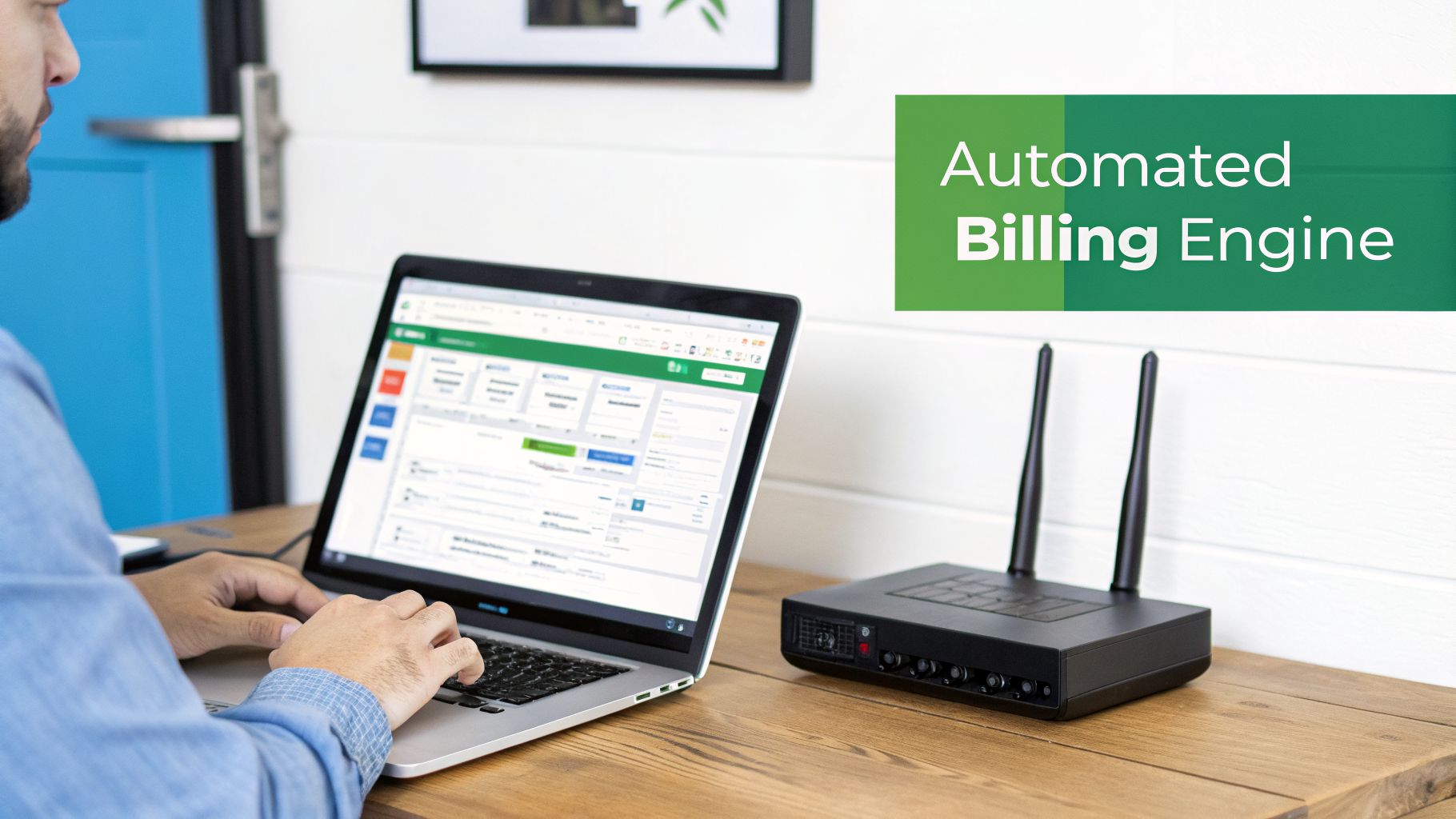
An ISP billing software is the automated engine that completely changes this manual struggle. It’s so much more than just a tool for sending out invoices; it's a complete operational command centre for your whole business.
From Manual Chaos to Automated Control
It’s like upgrading from a hand-cranked generator to a fully automated power grid. Instead of fighting with spreadsheets prone to errors and spending your days chasing late payments, the software does all the heavy lifting for you. For any internet business in Kenya wanting to scale up, making this shift is absolutely fundamental.
A good system takes care of the entire customer journey, from start to finish. As detailed in the official documentation at docs.centipidbilling.com, these platforms handle:
New Customer Sign-ups: It instantly onboards new subscribers and gets them set up on the right internet plan.
Automated Invoicing: It generates and sends out accurate invoices on a set schedule, with no need for you to lift a finger.
Payment Collection: It connects with popular payment methods like M-Pesa, allowing customers to pay easily while their accounts are updated in real-time.
By pulling all these different jobs into one place, you get a clear, at-a-glance view of active users, financial reports, and system alerts. Suddenly, all your critical business data is right there at your fingertips.
The Real Impact on Growth and Efficiency
In Kenya’s booming telecom sector, where mobile internet users shot past 30 million in 2023, automation isn’t a luxury anymore—it’s a matter of survival and growth. Adopting a solid ISP billing system is what allows providers to effectively handle the 18% year-on-year increase in broadband demand.
For example, many Nairobi-based WISPs who have made this switch have seen their average revenue per user (ARPU) climb from KES 800 to KES 1,200 monthly, simply by using real-time data and automated M-Pesa invoicing.
When you automate all that routine administrative work, you get your valuable time back. This lets you focus on the things that actually grow your business, like expanding your network coverage, improving customer service, and signing up more subscribers.
By unifying these functions, a powerful platform like the one from Centipid Technologies Ltd. gives you the solid foundation needed to build a successful and lasting internet business.
Core Features Your ISP Business Cannot Ignore
Think of your ISP billing software as the central nervous system of your operation, not just a fancy calculator. When you're choosing a platform, you need to look past the price tag. What truly matters are the core functions that will either save you headaches and money or create them. For any provider aiming to build a stable, scalable business, getting these features right is non-negotiable.
Automation That Works for You
At the top of the list is automated recurring billing. Let's be honest, manually creating and chasing invoices every month is a soul-crushing task. It's also a sure-fire way to introduce costly errors and slow down your cash flow. A solid billing system takes this off your plate, automatically generating and sending professional invoices right on schedule.
This hands-off approach should also cover the awkward task of chasing late payments. This is where smart dunning management comes in. Instead of your team spending hours on the phone with defaulters, the software can automatically send reminders, apply late fees, and even suspend a customer's service. The moment the balance is cleared, it can instantly restore their connection—no human intervention needed.
Now, let's look at the essential features you should expect from any modern ISP billing software. These aren't just nice-to-haves; they are the building blocks of an efficient and profitable network, and you can find them detailed on centipidbilling.com.
Essential ISP Billing Software Features
Feature | What It Does | Primary Benefit |
|---|---|---|
Automated Recurring Billing | Generates and sends invoices automatically on a set schedule. | Ensures consistent, predictable cash flow and eliminates manual errors. |
Dunning Management | Automatically manages overdue accounts with reminders, late fees, and service suspension. | Reduces time spent chasing payments and minimises revenue leakage. |
Plan & Package Management | Allows you to create, customise, and manage various internet service plans easily. | Provides the flexibility to compete and meet diverse customer demands. |
Customer Self-Service Portal | Gives subscribers a secure, branded portal to manage their own account. | Lowers your support ticket volume and empowers customers. |
Real-Time Analytics & Reporting | Provides a live dashboard of key business metrics like MRR and churn. | Offers the data you need to make informed, strategic decisions. |
Payment Gateway Integration | Connects with popular payment methods like M-Pesa, bank transfers, and cards. | Makes it simple and convenient for customers to pay you. |
These features work together to create a seamless experience for both you and your subscribers, turning your billing platform into a powerful growth engine.
Plan and Customer Management
Your ability to thrive in a crowded market comes down to how well you can package your services. A robust ISP billing software gives you the power to create and manage a whole menu of internet plans. This means easily setting different speeds, data caps, and prices to attract everyone from a student in a hostel to a small business needing a reliable connection.
Platforms like Centipid Billing make this process incredibly straightforward. You can adjust plans on the fly as your market changes or run promotions without getting tangled in technical weeds. You can explore this flexibility further in our detailed guide on generating and managing internet vouchers.
A key component of modern customer service is empowerment. A branded customer self-service portal is a non-negotiable feature that reduces your support workload while improving subscriber satisfaction.
Giving customers their own secure portal, a standard feature you can read about at docs.centipidbilling.com, means they can solve common issues themselves, anytime, day or night. This includes:
Viewing current and past invoices
Checking their data usage in real-time
Making instant payments through integrated gateways like M-Pesa
Upgrading or downgrading their internet plan without calling your support line
Data-Driven Decision Making
You can't fix what you can't see. Real-time analytics and reporting are your eyes and ears, giving you a live dashboard on the health of your ISP. This is where you get immediate insights into the numbers that actually matter.
We're talking about crucial metrics like your monthly recurring revenue (MRR), customer churn rate, payment success rates, and the number of active subscribers. By tracking these key performance indicators, you get the clarity needed to make smarter business moves. You can spot which plans are the most profitable, identify where payments are failing, and forecast your growth with far greater confidence.
Getting Your Billing Software and Network Gear to Talk
The real magic happens when your ISP billing software starts talking directly to your network hardware. This connection is what turns a simple billing platform into the automated heart of your operations, practically eliminating the need for manual work. For any ISP in Kenya, especially those building their networks on MikroTik RouterOS, this is the key to running a truly efficient business.
Think of your router as a super-diligent employee who never sleeps. The billing software is its manager, feeding it clear, instant instructions 24/7. This conversation happens through a time-tested protocol called RADIUS (Remote Authentication Dial-In User Service).
How RADIUS Puts Your Network on Autopilot
When a customer tries to get online, your router doesn’t just let them in. It first checks with the billing software via RADIUS, asking for permission. The software then looks at the customer's account in real-time.
Has the customer paid their bill? If yes, they’re granted access instantly.
Is their account overdue? Access is blocked until the payment comes through.
What package are they on? The software tells the router precisely what speed and data limits to apply.
This constant back-and-forth means your entire subscriber management process runs itself. A platform with solid MikroTik integration, like Centipid, lets you control all of this from a single place. For a deeper dive, check out our guide on getting the most out of Centipid Billing with MikroTik.
For hotspot operators, this integration is just as vital. The billing software is the engine that powers your captive portal—that familiar login page users see when they connect to your public Wi-Fi.
This isn't just about collecting money; it's about creating a seamless, automated customer experience. The software generates and validates access vouchers, manages session times, and applies bandwidth limits for each user, turning a simple router into a sophisticated public Wi-Fi management system.
The diagram below shows just how simple this automated journey becomes for a customer once your billing and network are connected.
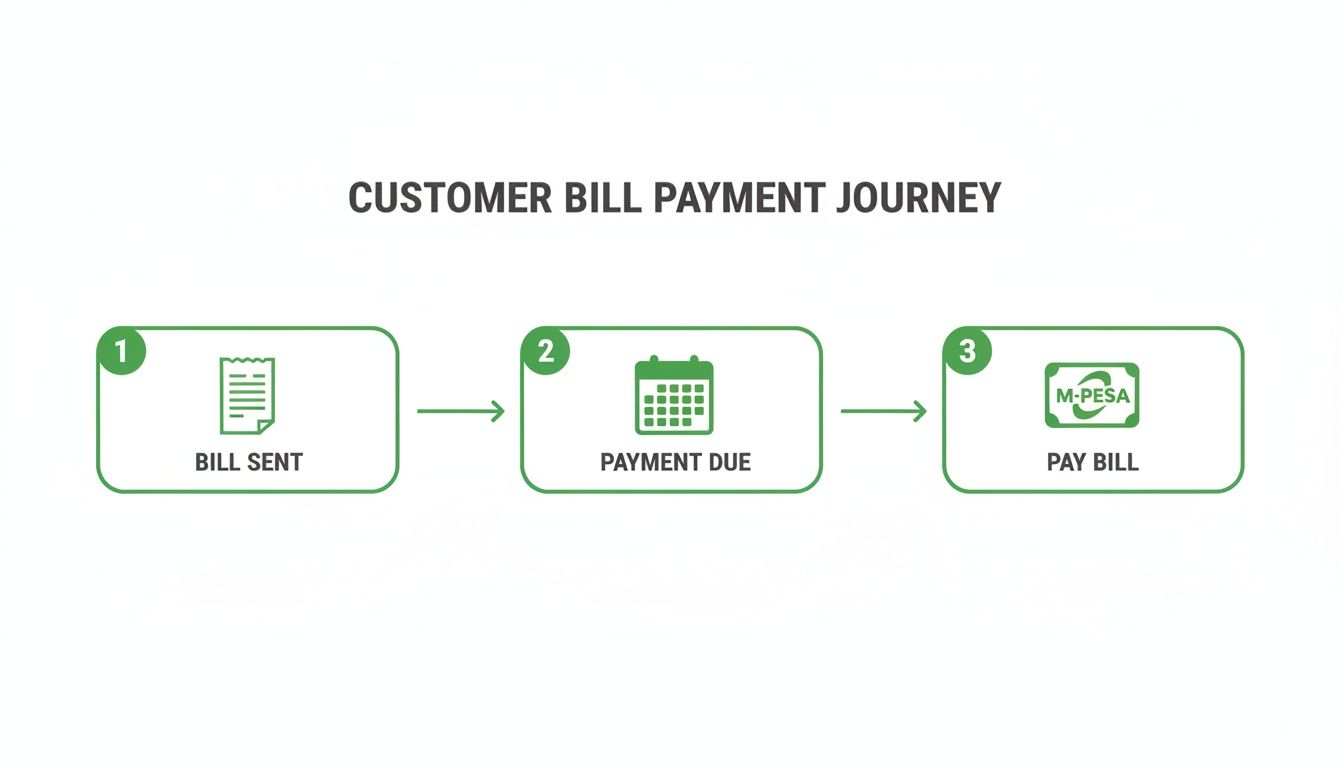
As you can see, the system handles everything from sending the invoice to processing the payment through gateways like M-PESA, which then automatically updates the customer's access status on the network.
The Power of PPPoE for Managing Subscribers
For ISPs serving homes and businesses, PPPoE (Point-to-Point Protocol over Ethernet) is the go-to method for managing individual connections. When you tie it into your billing system, it becomes an incredibly powerful automation tool.
Every customer gets a unique PPPoE username and password, which are stored and managed inside the billing software. When they connect, the RADIUS server checks these credentials, authenticates them, and applies their specific service plan.
If a customer is late on a payment, the software can automatically disable their PPPoE account, cutting off their internet. The moment they pay—say, via an integrated mobile money channel—the system instantly re-enables their account. This completely removes the tedious, manual work of suspending and reactivating customers, saving you countless hours and preventing unnecessary service calls. You can confirm how this works at docs.centipidbilling.com.
Choosing Your Software Deployment and Pricing Model
When you're looking at ISP billing software, you'll quickly realise they're not all created equal. A huge part of the decision comes down to how the software is actually delivered to you, and this choice will have a big impact on your costs, how much maintenance you're on the hook for, and how easily you can grow. It really comes down to two main options, each with its own set of trade-offs for your operations and your bank account.
The old-school route is to go with on-premise hardware. This means you buy your own server, install the software on it, and keep it running at your office or data centre. Think of it like owning your own power generator. You have total control, but you're also responsible for the hefty upfront cost, the installation, and all the ongoing maintenance, security, and updates. It requires real technical skill on your team to keep things humming along.
The Cloud Advantage for Modern ISPs
These days, most operators, especially new ones, are leaning towards cloud-based software. You'll often hear it called Software-as-a-Service, or SaaS. In this setup, the software lives on the provider's powerful servers, and you just log in through a web browser. This is more like plugging into the national power grid—you pay a predictable fee and get reliable service without ever having to worry about maintaining the power plant yourself.
Cloud systems like Centipid Billing have become the go-to for startup WISPs and hotspot providers for a few very practical reasons:
Low Entry Cost: There's no big, scary bill for server hardware right at the start. This frees up your cash for other critical things, like buying more network gear.
No Maintenance Headaches: The provider handles all the technical heavy lifting. Server maintenance, security updates, software patches—it's all done for you, behind the scenes.
Scalability on Demand: When your business takes off and you start signing up more customers, the system just scales with you. You don't have to scramble to buy and install a more powerful server.
For a new ISP, the flexibility of a cloud-based ISP billing software is a massive advantage. It lets you get off the ground fast with professional-grade tools, all while keeping your initial investment low and your monthly costs predictable.
Understanding Common Pricing Models
Just as important as how the software is hosted is how you'll pay for it. The pricing usually aligns with the way your business makes money, which makes a lot of sense when you think about it.
For networks running on PPPoE, a per-subscriber pricing model is very common. You simply pay a small, fixed fee each month for every active customer on your network. It's wonderfully straightforward because your software costs grow in lockstep with your revenue. No surprises.
For public Wi-Fi hotspot operators, it often makes more sense to use a percentage-based fee. With this model, the software provider takes a small cut of the revenue you generate from selling access vouchers. This is perfect for places like cafes, hotels, or event venues where customer traffic can be unpredictable. Your costs are directly tied to your sales. Centipid, for instance, offers both of these clear pricing models, which you can check out over at centipidbilling.com.
Automating Payments with M-Pesa and Bank Gateways
If you're running an ISP in Kenya, you know that getting paid on time means being where your customers are: on their phones. Manually chasing payments and reconciling M-Pesa messages is a huge drain on time and energy. This is where integrating a payment gateway directly into your ISP billing software isn't just helpful—it's a complete game-changer.
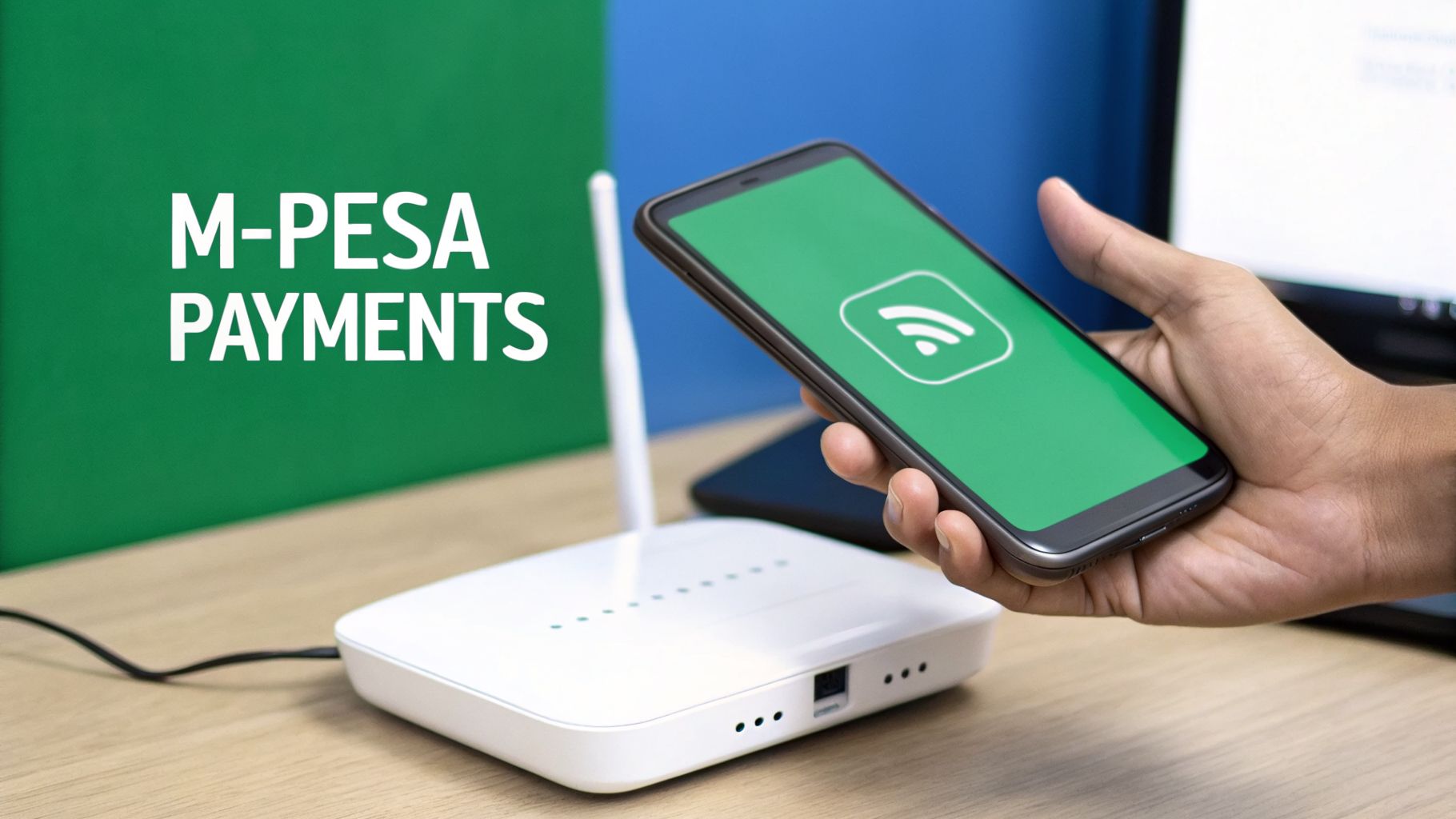
Imagine one of your customers gets disconnected for a late payment. Instead of them calling you, your system automatically sends an STK push to their phone. They just enter their PIN to pay the outstanding bill.
In that instant, the billing software gets a notification from M-Pesa, matches the payment to the correct invoice, and clears the balance. Most importantly, it immediately signals your MikroTik router to restore the customer's internet. The entire process, from payment to reconnection, happens in seconds, with zero manual work from you.
Turn Your Cash Flow Around with Smart Integrations
The impact of this kind of automation is massive. Before these systems became common, studies showed that 62% of small providers struggled with collection delays that stretched out to an average of 45 days. That's a long time to wait for your money.
By adopting an automated billing platform with strong gateway support, those same providers have cut payment delays down to under 10 days. That's a 35% boost in cash flow. The data also showed ISPs using these platforms saw their on-time payment rates climb by 28%, a significant lift for any business. You can see more on how this is changing the industry in this detailed report on billing software trends.
True financial flexibility comes from giving customers choices. While M-Pesa is essential, supporting multiple payment methods ensures you never miss a payment because a customer's preferred option wasn't available.
A solid platform like Centipid Billing is built to handle the realities of the Kenyan market, giving your subscribers the convenience to pay through:
Mobile Money: Direct, real-time integration with M-Pesa is non-negotiable.
Bank Transfers: Support for direct bank payments and other local financial services.
This isn't just about making customers happy; it's about building a healthier, more predictable business. To see exactly how this works behind the scenes, you can read our guide on the Lipa na M-Pesa portal integration. Ultimately, automating your payments secures your revenue and frees you up to focus on growing your network.
Your Checklist for Choosing and Migrating Your Software
Moving to a new ISP billing software can feel like a massive undertaking. The thought of disrupting service or losing customer data is enough to make anyone hesitate. But with a solid plan, you can sidestep the drama and make the switch a smooth one.
The entire process boils down to two main stages: picking the right software and then carefully moving your operations over to it.
Key Evaluation Criteria
Before you even look at a migration plan, you have to be absolutely sure the new platform is a good fit. Don't get distracted by flashy features; focus on what truly matters for your day-to-day business.
Here are the non-negotiable questions you should be asking:
Hardware Compatibility: Will this software talk to my network equipment without any fuss? For many of us, that means solid integration with our MikroTik routers.
Payment Gateway Support: Can it handle the payment methods our customers actually use? In Kenya, that means having direct, automated support for services like M-Pesa is essential.
Pricing Alignment: Does their pricing model make sense for my business? Whether it's a per-subscriber fee or a percentage of revenue, the numbers have to work for your budget.
Feature Set: Does it have all the core tools I need to run my ISP? Think about things like a customer self-service portal, automated payment reminders (dunning), and easy management of internet packages.
The only way to get real answers to these questions is to try the software for yourself. Most reputable platforms offer a free trial. For instance, you can sign up at centipidbilling.com to test its features and see if it genuinely meets your needs before making any commitment.
A Step-by-Step Migration Guide
Once you've settled on the perfect software, it's time to plan the move. A bit of preparation here will save you a world of headaches down the road.
Prepare Your Customer Data: Your customer list is your most important asset. The first job is to get it ready. Export all your current subscriber info—names, contacts, their active plans, and any outstanding balances—into a clean CSV file. This is the standard format most systems use for importing.
Configure Your Service Plans: Next, you need to rebuild your internet packages in the new system. Take the time to double-check that all your speeds, data caps, and prices are set up to perfectly match what you currently offer.
Execute a Phased Rollout: Whatever you do, don't try to move everyone at once. Start small. Migrate a handful of trusted test customers first. This lets you confirm that everything, from billing cycles to network authentication, is working flawlessly in a controlled environment.
Following a structured approach like this gives you a clear roadmap. It turns a daunting task into a series of manageable steps. For more detailed help, platforms like Centipid Billing provide extensive documentation to walk you through every stage of the process.
Frequently Asked Questions
Switching to a proper ISP billing system can feel like a big leap, especially if you're coming from spreadsheets or another platform. We get a lot of questions from providers just like you, so let's tackle some of the most common ones head-on.
How Difficult Is It to Integrate ISP Billing Software with My MikroTik Router?
This is probably the biggest worry we hear, but you’ll be relieved to know it's much simpler than you might think. Modern platforms like Centipid Billing are built specifically to talk to MikroTik routers. You definitely don’t need to be a coding expert to get it working.
The process usually just involves copying your router's API information into the billing software's dashboard and then applying a few straightforward configurations. You’re not left to figure it out alone, either. Good systems come with clear instructions, like the ones at docs.centipidbilling.com, and support teams ready to help. Most ISPs we work with are fully set up in a few hours, with the software ready to manage users and services automatically.
The whole point of good ISP billing software is to make your life simpler, not add another layer of complexity. The integration should feel like clicking a new piece into your network puzzle, with clear instructions to guide you.
Can I Import My Existing Customers from Spreadsheets?
Yes, absolutely. Any serious billing platform is designed for this. They recognise that you have an existing business and can't just start over from zero. You can almost always export your current customer data—names, contacts, plans, and even outstanding balances—into a standard CSV file.
From there, you simply upload that file into the new system. This is a core feature in platforms like Centipid Billing because it's vital for a smooth changeover. It saves you from days of mind-numbing manual entry and, more importantly, helps you avoid the small, costly mistakes that can frustrate customers.
What Happens if an M-Pesa Payment Fails to Update Automatically?
Even the most reliable automated systems can have hiccups. A temporary network drop or an API timeout can sometimes prevent a payment from posting instantly. But the money is never lost.
When this happens, the system immediately logs the transaction and flags it for an administrator to review on the dashboard. It’s a built-in safety net. What’s more, with a platform like Centipid Billing, the customer can see their full payment history in their own portal. If there's an issue, they can easily give your support team the transaction ID, allowing you to find the payment and credit their account in moments. No payment ever gets lost in the digital shuffle.
Ready to see how a purpose-built ISP billing software can really change your day-to-day operations? Centipid Technologies Ltd. offers a powerful, cloud-based platform made for Kenyan providers. Start your free trial today and discover a much smarter way to manage your network.